
Dressings And Condiments Emulsifiers: B2B Sourcing & Emulsion Stability Mastery
A comprehensive technical reference for food scientists, R&D formulators, and global procurement executives seeking high-performance stabilization systems, clean-label plant hydrocolloids, and bulk emulsifiers for commercial sauces, mayonnaise, and pourable dressings.
Key Formulation Takeaways
- HLB Precision: Match lipophilic (HLB 3-6) and hydrophilic (HLB 8-16) surfactants to stop phase separation in high-acid environments.
- Clean-Label Alternatives: Replace egg yolk and synthetic polysorbates with hydrolyzed sunflower lecithin and pea protein isolates.
- Shear & Thermal Resistance: Maintain viscoelastic stability under high-speed continuous homogenization and cold-chain thermal cycles.
- Quality Assurance: Verified GFSI, Kosher, Halal, Non-GMO Project Verified, and low micro-contaminant compliance (3-MCPD / GE).
The Fundamental Role of Emulsifiers in Industrial Condiment Manufacturing
In industrial food processing, dressings and condiments—ranging from thick spoonable mayonnaise to pourable vinaigrettes and creamy dipping sauces—represent complex multi-phase thermodynamic systems. The fundamental challenge for R&D food scientists is stabilization: preventing the natural thermodynamic drive for hydrophobic oil droplets and hydrophilic aqueous phases to segregate into distinct layers via creamening, flocculation, coalescence, and Ostwald ripening.
Commercial Dressings And Condiments Emulsifiers act as surface-active agents (surfactants) containing both hydrophilic (water-loving) and lipophilic (fat-loving) moieties. By adsorbing rapidly at the oil-water interface during high-shear blending, these amphiphilic molecules lower interfacial tension, reduce droplet diameter to sub-micron scales, and create protective steric or electrostatic barriers that inhibit droplet fusion over an extended commercial shelf life.
With ICI Foods' 50+ years of ingredient sourcing excellence, procurement officers gain access to a curated portfolio of functional emulsifiers designed to withstand acidic pH (pH 2.8–4.2), high ionic strength (salinity), and mechanical stress encountered during industrial bottling, aseptic filling, and shipping logistics.
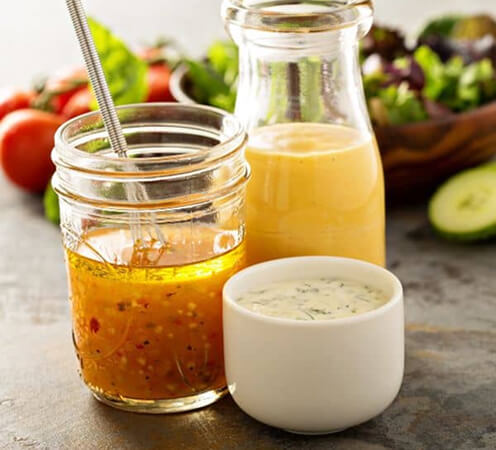
Industrial Emulsifier Portfolio for Sauces & Dressings
Explore our full line of functional surfactants, hydrocolloid complexes, and lecithin grades engineered specifically for heavy-duty food production applications.
Fluid & De-Oiled Lecithin (Soy & Sunflower)
Primary Function: Natural amphiphilic emulsifier rich in phosphatidylcholine (PC) and phosphatidylethanolamine (PE).
Ideal For: Pourable dressings, pan-release sauces, low-fat spreads, and egg-free plant mayonnaise formulations.
Key Value: Non-GMO, allergen-free options (sunflower) with high dispersion speed in cold oil phases.
Distilled Mono- & Diglycerides (DMG)
Primary Function: Lipophilic surfactant (HLB 3.5–4.5) providing firm structural network and fat crystallization control.
Ideal For: High-fat dips, margarine spreads, pan sauces, and spoonable salad creams.
Key Value: High purity (>90% monoglyceride content), superior water-binding capacity, and high-heat resistance.
Polyglycerol Polyricinoleate (PGPR) & PGE
Primary Function: Ultra-strong water-in-oil (W/O) emulsification reducing yield stress and controlling rheology.
Ideal For: Reduced-fat spreads, emulsion-based marinades, and high-viscosity chili oil condiments.
Key Value: Exceptional interfacial tension reduction allowing up to 70% water inclusion in fat-continuous matrices.
Sodium Stearoyl Lactylate (SSL)
Primary Function: Ionic hydrophilic emulsifier (HLB ~10-12) forming strong electrostatic interaction complexes.
Ideal For: Creamy ranch dressings, processed cheese sauces, and heat-processed gravy systems.
Key Value: Enhances freeze-thaw stability, improves mouthfeel, and prevents fat syneresis during retort heating.
Clean-Label Hydrocolloids & Plant Proteins
Primary Function: Pickering stabilization systems combining surface-active proteins with viscosity-building gums.
Ideal For: Ultra-clean label, vegan, keto, and zero-egg commercial salad dressings.
Key Value: Modified tapioca starch, pea protein isolates, and acacia gum offering 100% natural label declarations.
Polysorbate 60 & Sorbitan Monostearate
Primary Function: High HLB synthetic emulsifiers providing bulletproof emulsion clarity and stability.
Ideal For: Clear oil-and-vinegar dressings, flavor oil solubilization, and acidic condiment sprays.
Key Value: Extreme stability across low pH (down to 2.5) and high salt environments without phase break.
Technical Specification Matrix: Emulsifier Selection by Application
Use this reference table to evaluate Hydrophilic-Lipophilic Balance (HLB), recommended inclusion levels, and thermal boundaries when formulating sauces and dressings.
| Emulsifier Type | HLB Value | Target Application | Inclusion Rate (%) | pH Tolerance | Thermal Stability |
|---|---|---|---|---|---|
| Enzymatically Modified Sunflower Lecithin | 8.0 – 9.5 | Egg-Free Mayonnaise & Creamy Sauces | 0.5% – 1.5% | 3.0 – 7.5 | Up to 85°C (Pasteurization) |
| Distilled Monoglycerides (DMG) | 3.5 – 4.5 | Emulsified Spreads & Margarine | 0.2% – 0.8% | 4.0 – 8.0 | High (>100°C Cooking Stability) |
| Polyglycerol Polyricinoleate (PGPR) | 1.5 – 3.0 | Low-Fat Water-in-Oil Condiments | 0.1% – 0.5% | 3.2 – 7.0 | Moderate (UHT Tolerant) |
| Sodium Stearoyl Lactylate (SSL) | 10.0 – 12.0 | Ranch & Cream-Based Bottled Dressings | 0.2% – 0.5% | 3.5 – 7.0 | Freeze-Thaw Stable |
| Pea Protein Isolate + Xanthan Gum | Complex (Pickering) | Vegan / Clean-Label Vinaigrettes | 1.0% – 2.5% | 3.2 – 6.5 | High Shear / Moderate Heat |
| Polysorbate 60 | 14.9 | High-Acid Flavor Oil Emulsions | 0.05% – 0.3% | 2.5 – 8.0 | Extreme Thermal Resistance |
Future Product & Formulation Trends in Condiment Emulsification (2026–2030)
The global dressings and condiments sector is undergoing a rapid transformation driven by shifting consumer health demands, regulatory pressures, and cost-efficiency requirements in high-speed manufacturing. Formulators and procurement professionals must stay ahead of several core micro and macro-trends shaping emulsifier selection:
1. The Shift to "Clean-Label" & E-Number Elimination
Consumers across North America and Europe actively scrutinize back-of-pack ingredient statements, seeking simple, recognizable terms. Synthetic surfactants like Polysorbates (E433, E435), DATEM, and Polyglycerol Esters are facing reformulating pressure. Leading manufacturers are shifting toward non-GMO sunflower lecithin, enzymatic lyso-lecithin, and plant proteins (pea, faba bean, chickpea) that double as functional emulsifiers while maintaining a clean "Plant Protein" or "Sunflower Lecithin" label.
2. Ultra-Low Fat Condiments via Pickering Emulsion Technology
With the rise of low-calorie, keto-friendly, and health-focused dietary patterns, food developers are challenged to formulate salad dressings and mayonnaise products with oil contents reduced from 80% to under 25% without sacrificing the mouthfeel, opacity, and body of full-fat counterparts. Advanced Pickering stabilization—utilizing insoluble micro-particulate starch, citrus fibers, and microcrystalline cellulose—forms a physical particulate armor around oil droplets, preventing coalescence in high-water systems.
3. Cold-Process & Energy-Efficient Manufacturing
Energy costs remain a primary driver of industrial manufacturing expenses. Traditional emulsification often requires thermal activation to melt hard fats or hydrate gums. Next-generation liquid lecithin formulations and cold-water-soluble mono-diglyceride derivatives enable instant emulsification at ambient temperatures (15°C–22°C), cutting thermal utility overhead by up to 35% in high-volume sauce operations.
4. Egg-Free and Vegan Mayonnaise Reformulation
Egg yolk has historically served as the gold standard emulsifier for mayonnaise due to its high native lecithin and lipovitellin content. However, egg supply chain volatility (driven by avian influenza outbreaks), allergen declaration requirements, and vegan demand have accelerated the adoption of tailored plant protein-hydrocolloid emulsifier blends that mimic the exact viscoelastic profile and shear-thinning behavior of egg yolk.
Formulation Expertise Tip from ICI Foods R&D
When transitioning from egg yolk to plant-based emulsifiers in high-acid mayonnaise (pH < 3.8), remember that plant proteins approach their isoelectric point around pH 4.0–4.5, where solubility drops. Utilizing enzymatically modified lecithin alongside cold-swelling tapioca starch ensures strong electrostatic repulsion and prevents phase separation across extended ambient storage.
Global Procurement Trends & Supply Chain Risk Mitigation
Procuring industrial food emulsifiers at enterprise scale requires far more than finding the lowest unit price per kilogram. Sourcing executives face supply chain shocks, geopolitical disruptions in oilseed harvests, tightening micro-contaminant safety standards, and strict sustainability mandates.
Key Procurement Imperatives for Buying Executives:
- Multi-Origin Sourcing Strategies: Reliance on single-geography raw materials (e.g., Eastern European sunflower seeds or South American soy) creates critical production vulnerabilities. Dual-sourcing raw materials across geographical hubs protects against crop failures and trade tariffs.
- 3-MCPD & Glycidyl Esters (GE) Strict Compliance: EU and US FDA regulations set ultra-low safety thresholds for processing contaminants in refined fats and emulsifiers. High-purity distilled monoglycerides and lecithin must be certified for low ester contaminants to clear international regulatory hurdles.
- Total Cost of Ownership (TCO) Optimization: Evaluating an emulsifier’s true economic impact involves looking beyond bulk pricing to inclusion efficiency. High-potency active monoglycerides with a lower dosing rate (0.2%) frequently yield a lower per-batch cost than lower-grade alternatives requiring 0.8% inclusion rates.
- Just-In-Time (JIT) Warehousing & Inventory Resilience: Maintaining localized inventory hubs prevents line shutdowns during port delays. ICI Foods operates strategic warehousing networks to ensure uninterrupted delivery schedules.
Frequently Asked Questions (FAQ) for Food Procurement & R&D
Get authoritative answers to complex technical questions commonly raised by food formulation engineers and global purchasing directors.
How do I calculate and select the ideal Hydrophilic-Lipophilic Balance (HLB) for pourable salad dressings versus thick spoonable mayonnaise?
The required HLB depends directly on the continuous phase of your emulsion. For oil-in-water (O/W) systems like pourable dressings and mayonnaise (where water is the continuous phase), emulsifiers with higher HLB values (8 to 16) are required to coat oil droplets. Pourable dressings typically utilize hydrocolloid-lecithin blends (HLB 8–10) combined with thickeners. Spoonable mayonnaise relies on tight packing of oil droplets stabilized by egg yolk or enzymatic lyso-lecithin (HLB 9–12). For water-in-oil (W/O) spreads, lower HLB emulsifiers (3 to 6) like distilled monoglycerides or PGPR are selected.
What are the primary causes of emulsion breakdown during shelf-life storage, and how do specialized emulsifiers prevent it?
Emulsion failure occurs via four main mechanisms: Creaming (gravitational movement of droplets), Flocculation (clumping without droplet fusion), Coalescence (droplets merging into larger droplets), and Phase Inversion. Coalescence is caused by weak interfacial film strength. Adding high-purity mono-diglycerides or modified lecithin increases the viscoelastic strength of the interfacial film, while ionic co-emulsifiers like SSL generate electrostatic repulsion (zeta potential > |30| mV) that keeps droplets separated over 12–24 month shelf cycles.
How can manufacturers transition from egg yolk to clean-label plant emulsifiers without losing texture and viscosity?
Replacing egg yolk requires a dual strategy: interfacial stabilization and rheology compensation. Plant proteins (such as pea or chickpea isolates) provide the interfacial surfactant action, but lack egg yolk's natural thermal gelation and fat-structuring properties. Combining plant proteins (1.0%–2.0%) with modified tapioca starch or xanthan gum (0.2%–0.4%) restores yield stress, shear-thinning mouthfeel, and texture without altering processing parameters.
What documentation and quality certifications should I require when importing bulk dressings and condiments emulsifiers?
Essential quality and compliance documentation includes: Certificate of Analysis (CoA) matching active monoglyceride or phospholipid specifications, Safety Data Sheet (SDS), Allergen Breakdown Declaration, Non-GMO Project Verification or IP (Identity Preserved) Certificate, GFSI Audit Certification (SQF, BRCGS, or FSSC 22000), Kosher and Halal Certifications, and heavy metal / micro-contaminant testing (specifically 3-MCPD, GE, and pesticide residue screens).
How does high-shear homogenization impact emulsifier dosage requirements in commercial production?
Higher shear rates (e.g., using colloid mills or rotor-stator homogenizers at 3,000–8,000 RPM) break oil droplets into significantly smaller average diameters (d32 < 1 micron). Smaller droplets dramatically increase the total oil-water surface area across the batch. Consequently, high-shear processing requires a higher total quantity of emulsifier to achieve complete monolayer coverage of the newly created interfacial area and prevent immediate post-homogenization coalescence.
Which emulsifiers offer the best freeze-thaw stability for frozen prepared meals containing sauces or dressings?
Freezing causes ice crystal formation that punctures interfacial surfactant films, leading to oil separation upon thawing. Hydrophilic ionic emulsifiers such as Sodium Stearoyl Lactylate (SSL) and Polyglycerol Esters (PGE), when combined with freeze-thaw stable modified starches and guar gum, create a flexible, elastic interfacial network that survives ice crystal growth and thermal stress.

The ICI Foods Advantage in Ingredient Distribution
For over 50 years, ICI Foods has served as a primary B2B bridge connecting global food ingredient manufacturers with commercial food producers across North America. We provide end-to-end reliability for your supply chain.
- 50+ Years of Industry Leadership: Deep technical mastery in ingredient chemistry, emulsification, and functional food formulation.
- Vetted Global Supplier Network: Relationships with over 200 premier, fully-audited global ingredient manufacturers.
- Uncompromising Food Safety: Operations fully aligned with SQF, FSMA, GFSI, Kosher, and Organic standards.
- JIT Warehousing & Distribution: Strategically positioned cold and ambient storage hubs eliminating stockouts.
- Dedicated Technical & R&D Support: On-staff food scientists ready to assist with pilot testing, HLB calculations, and cost-reduction reformulations.
Accelerate Your Formulation Success with ICI Foods
Whether you are developing a clean-label vegan dressing, optimizing a low-fat sauce, or securing bulk lecithin supply contracts, our ingredient specialists are standing by.