
Industry Insights
Food & Beverage Ingredient Blog
Formulation guides, ingredient sourcing insights, and market trends from ICI Foods experts.
China Top Bulk Honey Ingredients Manufacturers?
Table of Contents
- Defining Bulk Honey Ingredients and Their Industrial Applications
- China’s Major Bulk Honey Ingredient Manufacturing Regions
- Key Product Types and Processing Capabilities
- Quality Standards, Certifications, and Supply Chain Management
- How to Evaluate and Select a Chinese Honey Ingredients Manufacturer
- FAQS
- Conclusion
- Related Posts
China has become an important sourcing market for Bulk Honey Ingredients, including liquid honey, honey powder, honey blends, and food-grade honey preparations. Manufacturers serve beverage, bakery, dairy, confectionery, nutrition, and personal care applications. Yet factory selection requires more than comparing prices. A reliable supplier should explain floral source, harvest region, processing conditions, moisture content, and batch consistency. Clear answers matter.
This guide examines China’s leading bulk honey ingredient manufacturers through practical purchasing criteria. It considers production capacity, laboratory testing, traceability systems, export experience, packaging options, and private-label support. Certifications such as HACCP, ISO 22000, BRCGS, organic approval, and relevant market documentation may strengthen supplier credibility. However, certificates should be verified directly. A polished website proves little.
Experienced buyers also inspect samples under real conditions. Does the honey dissolve smoothly in warm tea? Does the powder remain free-flowing after transport? Does the aroma stay natural after storage? Small details can expose large differences. Supplier communication is another useful test. Delayed replies, vague specifications, or changing test results deserve attention. Not every manufacturer fits every application. Some may offer impressive volume but limited formulation support. Others may provide strong customization but higher minimum orders. This is where the evaluation becomes less neat. Product quality can vary between seasons, and published claims may not tell the whole story. Careful audits, independent testing, and written specifications remain essential before signing a supply agreement.
Defining Bulk Honey Ingredients and Their Industrial Applications
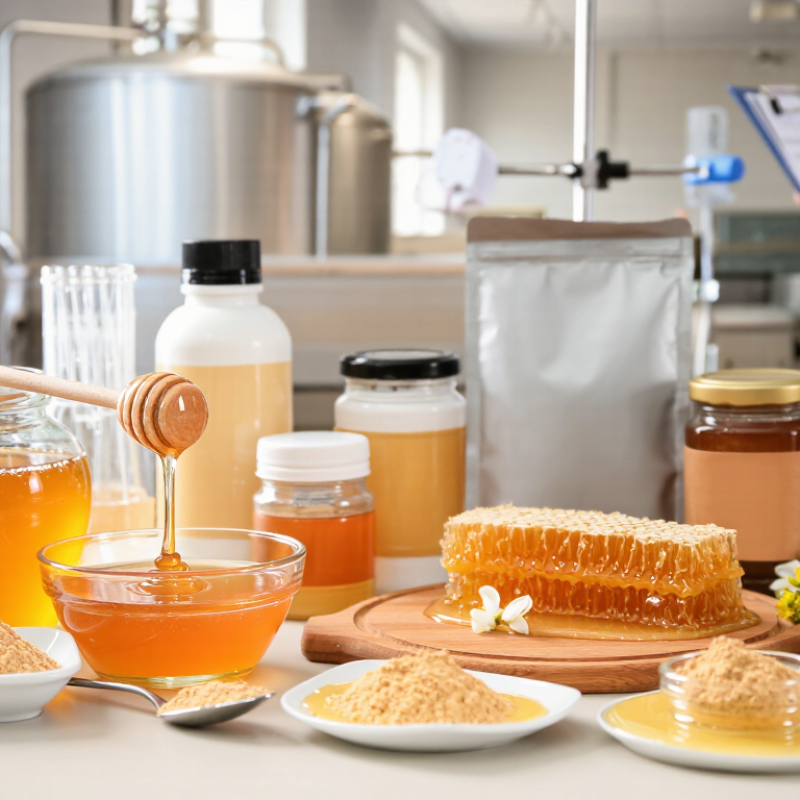
Bulk honey ingredients are honey-based materials supplied in industrial quantities for further processing. They may include liquid honey, filtered honey, blended honey, or dehydrated honey powder. Each form behaves differently during storage and production. Moisture, color, flavor, viscosity, and crystallization tendency require careful control.
In bakery production, liquid honey adds sweetness, softness, browning, and moisture retention. It can help cookies remain tender after cooling. Beverage manufacturers use honey solutions in teas, functional drinks, and dairy products. Honey powder is useful when a dry recipe needs honey flavor without extra liquid. Sauce and dressing producers may select darker honey for stronger taste and deeper color. Temperature matters. Excessive heating can weaken desirable aroma compounds and affect quality indicators such as hydroxymethylfurfural levels.
Reliable industrial sourcing requires more than a low price. A qualified manufacturer should provide batch records, laboratory test results, allergen statements, origin details, and traceability documents. Sanitation controls are equally important, especially for open handling and filling lines. Storage conditions also deserve attention; warm warehouses may accelerate flavor changes and crystallization. A practical caution remains: one specification rarely fits every factory. A beverage plant may need a light, easily dissolving honey, while a bakery may prefer stronger flavor and higher viscosity. Even small differences can alter texture. This is where assumptions fail, and pilot trials become necessary.
China’s Major Bulk Honey Ingredient Manufacturing Regions
China’s major bulk honey ingredient manufacturing regions follow both beekeeping resources and processing infrastructure. FAOSTAT records China’s honey production at approximately 466,000 tonnes in 2022. This large supply supports liquid honey, filtered honey, honey powder, and blended ingredient production.
Zhejiang and Jiangsu have strong food-processing networks, export services, and laboratory capacity. They often handle filtration, blending, packing, and ingredient customization. Hubei and Anhui benefit from extensive rapeseed-growing areas, supporting seasonal honey collection. Jilin and Heilongjiang are known for forest and northern floral sources, including linden-type honey. Sichuan and Yunnan also contribute diverse floral materials, although supply can change with rainfall and flowering conditions.
Regional boundaries are not perfectly clear. A manufacturer may source honey from several provinces, then process it elsewhere. China Customs data and FAOSTAT help assess trade and production, but they cannot verify every supplier’s quality. The 2023 China Statistical Yearbook is useful for checking agricultural patterns, while laboratory audits remain essential.
Tips: Ask for batch-level origin records, moisture results, HMF testing, pesticide screening, and traceability documents. Confirm whether the quoted material is pure honey, a standardized blend, or dried honey powder. A low price may reflect different specifications. That deserves careful review.
Key Product Types and Processing Capabilities
China’s leading bulk honey ingredient manufacturers usually offer several product types for food, beverage, bakery, and nutrition applications. Common options include liquid honey, creamed honey, honey powder, and honey blends. Light floral honey suits delicate drinks and sauces. Darker varieties provide stronger flavor and color. Honey powder is useful in dry mixes, instant beverages, and seasoning systems.
Processing capability often separates reliable suppliers from ordinary traders. Experienced factories use controlled filtration to remove wax particles while retaining natural flavor. Gentle heating helps reduce crystallization without excessively damaging aroma. Some facilities provide pasteurization, moisture adjustment, spray drying, and fine grinding for powdered ingredients.
Batch testing may cover moisture, sugar profile, microbiological safety, heavy metals, and authenticity indicators. Traceability should connect each lot with its source, processing date, and packaging record. Still, no process is perfect. Excessive heat can flatten flavor, while weak filtration can affect appearance.
Tips: Ask for a technical data sheet and recent batch results. Confirm the honey’s origin, floral source, moisture range, and intended application. Request a small sample before approving bulk production. Compare performance after storage, not only on delivery day.
Packaging also matters. Food-grade drums, pails, or lined bags should protect against moisture, light, and unwanted odors. A clear complaint procedure is valuable when texture or color changes unexpectedly.
Quality Standards, Certifications, and Supply Chain Management
Selecting China’s top bulk honey ingredients manufacturers requires more than comparing price per drum. Quality begins with the apiary and continues through extraction, blending, storage, and export. FAOSTAT data for 2022 recorded global honey production at roughly 1.8 million tonnes, making reliable origin control increasingly important. Serious suppliers should follow Codex Standard 12-1981 and maintain documented HACCP procedures.
Certification must support real testing, not decorate a brochure. Buyers should request ISO 22000 or an equivalent GFSI-recognized food safety certification, alongside recent laboratory results. Typical checks include moisture, hydroxymethylfurfural, diastase activity, pesticide residues, antibiotics, heavy metals, and sugar-syrup adulteration. Stable-isotope testing can strengthen authenticity verification. The European Commission’s 2023 coordinated action found that 46% of sampled imported honey showed suspicion of non-compliance, according to its published report. That figure deserves attention.
Supply chain management is equally practical. Each lot should carry a harvest location, production date, batch number, and test record. Sealed food-grade drums, clean warehouses, and controlled storage help protect flavor and consistency. Temperature discipline matters, although honey is not a fragile pharmaceutical. Shipment records should connect the container to the exact laboratory report. Gaps still occur, especially when brokers handle mixed origins. That is where buyers should slow down. A small pre-shipment sample, independent testing, and a written recall procedure can expose weaknesses before a full container leaves China. The process may feel repetitive. It is still cheaper than rejecting an entire shipment.
How to Evaluate and Select a Chinese Honey Ingredients Manufacturer
Selecting a Chinese bulk honey ingredients manufacturer requires more than comparing prices. FAOSTAT recorded China’s honey production at roughly 460,000 metric tons in 2022, showing strong supply capacity. Capacity alone proves little. Ask for harvest-region details, batch records, and evidence of stable processing controls.
Request a recent certificate of analysis for every commercial batch. Check moisture, HMF, diastase activity, sugar profile, pesticide residues, antibiotics, heavy metals, and microbiological results. The Codex Standard for Honey provides useful reference limits, while ISO 22000 certification can indicate a structured food-safety system. Still, certificates can become outdated. Confirm the testing laboratory, sample date, and laboratory accreditation.
Audit the factory if volumes justify it. Observe drum sealing, temperature control, filtration, allergen handling, and warehouse cleanliness. USDA Foreign Agricultural Service reports continue to identify China as a major participant in global honey trade, so traceability should be tested, not assumed. Request a mock recall from harvest lot to finished drum. It should be quick and complete.
Look closely at technical support. Can the manufacturer adjust color, flavor, viscosity, or crystallization for bakery and beverage applications? Ask for pilot samples under your actual processing conditions. Some suppliers respond well during sampling, then weaken after contracts are signed. That risk is easy to miss. A written specification, change-notification clause, inspection rights, and realistic lead-time records provide stronger protection than attractive quotations. Supplier selection is partly technical, partly behavioral. Expect imperfections, and document them early.
FAQS
Zhejiang and Jiangsu offer strong processing and laboratory networks. Hubei and Anhui benefit from rapeseed-growing areas. Northern regions provide forest and linden-type honey. Sichuan and Yunnan add diverse floral sources. Regional boundaries can overlap.
Common products include liquid honey, creamed honey, honey powder, and blended honey. Liquid honey suits beverages and sauces. Honey powder fits dry mixes and instant drinks. Dark honey adds stronger flavor and color.
Request batch-level origin records and floral-source details. Ask for harvest regions, processing dates, and packaging records. A supplier may combine honey from several provinces. One location on a quotation may not tell the whole story.
Request moisture, HMF, sugar profile, microbiological, pesticide, antibiotic, and heavy-metal results. Check the sample date and testing laboratory. Recent results matter more than old certificates. Testing is useful, but it does not prove everything.
Ask whether the facility performs filtration, gentle heating, moisture adjustment, pasteurization, or spray drying. Confirm how crystallization is controlled. Excessive heat can flatten aroma. Weak filtration can leave visible particles.
Food-grade drums, pails, or lined bags can protect the product. Packaging should resist moisture, light, and unwanted odors. Inspect seals carefully. A damaged liner can quietly affect quality.
Yes, test a small sample under your actual production conditions. Check flavor, color, viscosity, and crystallization after storage. Delivery-day performance is not enough. I would not approve bulk production too quickly.
Use a written specification covering origin, moisture, flavor, testing, packaging, and shelf life. Add change-notification and inspection clauses. Request realistic lead-time records. Include a clear complaint procedure and mock-recall requirement. No checklist is flawless.
Conclusion
China’s bulk honey ingredient industry supplies honey-based materials for food, beverage, bakery, confectionery, nutritional, and cosmetic applications. Bulk Honey Ingredients may include liquid honey, filtered honey, honey powder, blended honey preparations, and customized formulations designed for different flavor, moisture, texture, and shelf-life requirements. Manufacturing activity is concentrated in agricultural regions with strong beekeeping resources, processing infrastructure, and access to domestic and export transportation networks.
When evaluating a Chinese manufacturer, buyers should examine processing capabilities, raw material sourcing, traceability, laboratory testing, and production consistency. Important considerations include food safety systems, relevant certifications, allergen controls, residue testing, packaging options, storage conditions, and supply chain reliability. A suitable supplier should also provide clear technical documentation, responsive communication, flexible order volumes, and stable quality across batches. Comparing samples, audit results, certifications, lead times, and total landed costs can help importers select a dependable partner for long-term supply.

Blog Tags: